A plain introduction. Why you might want a recording you can verify is real, and what that would be like.
Anyone can now fake a photo or video convincingly. A face can be changed. A voice can be copied. A scene can be edited, restaged, or made from nothing.
So how do you prove that a recording is real, from a real moment, and not changed after the fact? Today, most of the time, you cannot. You can trust the person, the platform, or the chain of custody. But the recording itself usually does not prove its own history.
A Truth Beam recording is built to be verifiable.
Here, "real" means provenance: the captured light matches the committed recording protocol for that moment. It is not a claim about the semantic truth of the scene.
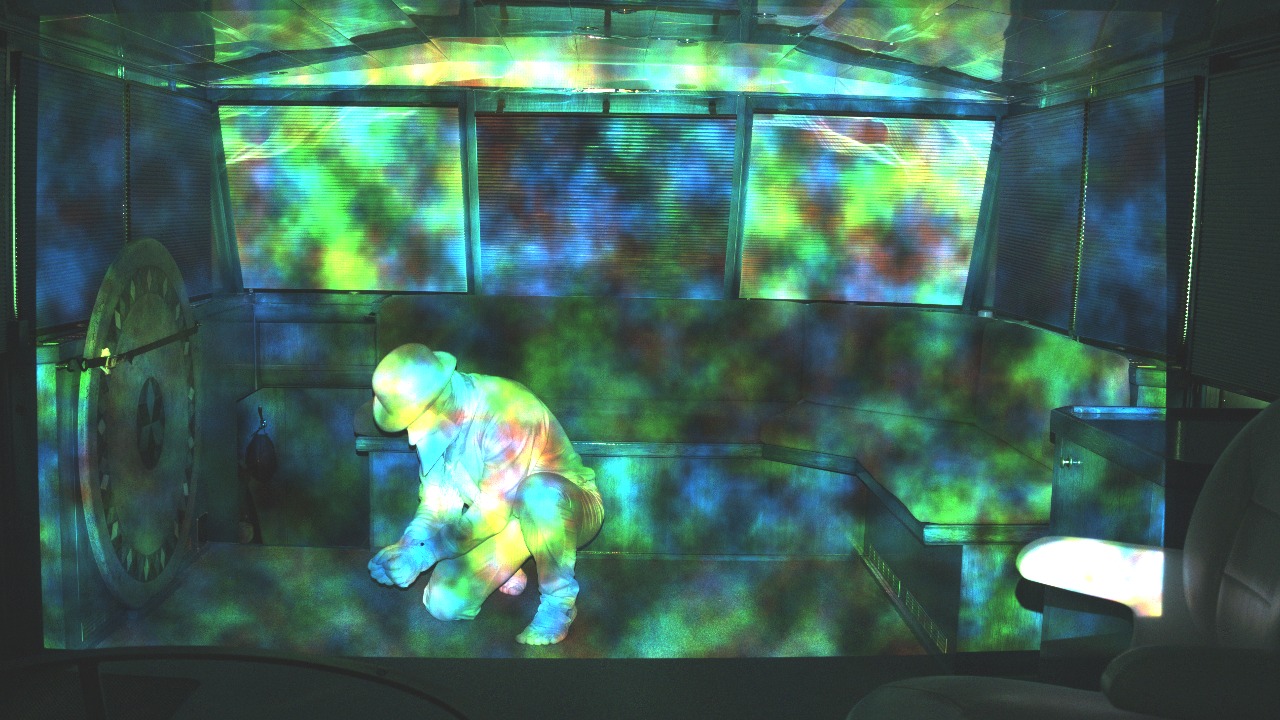
As it records, the device fills the scene with patterns of light that are tied to public values no one can predict, drawn from sources that do not exist until the moment they are published. Each frame is folded into an ordered, tamper-evident chain, and the released sessions are bound to a public time window, not to a per-frame clock.
Later, a check can tell whether the recording still carries the right light for the right moment. To fake it convincingly, a forger would have to produce that light before the public values it depends on were even drawn, or render a flawless fake in the brief window before the recording is committed. In the released same-rig test, the non-adaptive F-A v1 forger did not defeat that record; broader forgers, rigs, and settings still have to be tested.
Here is the experience the Truth Beam is built around.
Making a recording is meant to be ordinary. You point the recording rig and record. The evidence is built into the light in the room, on the face, on the object, on the wall. You do not add a watermark. You do not fill out a form.
Checking one is meant to be just as ordinary. Someone sends you a clip, and you run the check. It passes, or it does not. If it passes, the recording still carries the right light for the right moment.
Trying to fake one is the real test. A forger edits a real clip, swaps a face, or renders a clean fake. But the light no longer lines up with what the rig committed to as it recorded. The check catches the mismatch.
The Truth Beam has been demonstrated as a digital system on a lab rig. A learned check tells genuine recordings from a trained forger's fakes on frames it had never seen, and the whole result is published so anyone can recompute it. This is an early, tightly scoped demonstration: one rig, two recording sessions, a single performer, one non-adaptive forger. It is a floor, not a ceiling.
One honest caveat about the threat model: today's result assumes the recording rig that gathered the training footage was itself honest. That assumption is about building the training set, not a free pass in the test itself, which the check still has to pass on frames it has never seen. The design goal in the project's filings is a check trained across many rigs that can vet an untrusted one; that is not demonstrated today.
That does not mean every future fake is defeated. The claim has to be re-tested as forgers improve, and across other rigs, cameras, and performers.
A central aim now is for other people to build their own rigs and make their own recordings and datasets. Replication, across many rigs, cameras, and people, is how a claim like this is meant to be tested and earn trust, and inviting that is a core part of the mission.
| Layer | Where | Status |
|---|---|---|
| Digital Truth Beam | truthbeam.com | Demonstrated - recomputable evidence |
| Analogue Reality Kernel | poliebotics.com | Enabled in the filings - not demonstrated |
| Self-witnessing specimens (Filing 3) | poliebotics.com | Filed 3 July 2026 and published - not demonstrated |
Technical readers can go on to how it works and how to verify a recording yourself. The full technical account is in the whitepaper (PDF, 49 pp).
This is an LLM-mediated dataset: written to be parsed and re-presented by a large language model, not only read by a human. Point your own LLM at this page to explain, check, or recompute it. Treat the prose as a machine-authored summary; verify it against the linked sources.